

Holding a Boundary With the People We Love
Why our boundaries with family turn into walls, ultimatums, or arguments despite our best intentions, and what helps a boundary be heard and held over time.
Relationships & Intimacy
Nov 18
Staying Without Disappearing - Essay 2
Many of us abandon ourselves with our families, and we don't notice it until the drive home, when we feel empty, exhausted, and strangely sad. We set aside what we need, what we feel, and what we want to say, so that we can stay close to the people we love. It is a painful thing to do to ourselves, and most of us learned to do it as children, long before we had any say in the matter.
You can be grounded, clear, and confident in every other part of your life. Then you spend an afternoon with your family, and within an hour you are refilling everyone's glasses, smoothing over your father's comment, and watching your sister's face for the first sign of a bad mood. You feel yourself shrinking into someone you outgrew years ago, and you can't stop it. Later, alone in the car, the hurt and the frustration come up together: "Where did I go? Why do I lose myself every time I'm with them?"
If that question is familiar, please know how much sense it makes. You are doing what you learned to do as a child to keep the people you depended on close. That old survival pattern is the role you were handed. In the last essay, we looked at fear, obligation, and guilt; the fog that makes us say yes when we mean no. This is where fear, obligation, and guilt first took hold of us: in a family role you took on so young that it came to feel like who you are. I have seen this in clients, in couples, and in my own family, and I know how lonely it can feel to sit among the people who raised you and still feel unseen.
Children are exquisitely sensitive to the people they depend on. They feel the tension in a parent's jaw, the heavy silence after an argument, the change in a voice that signals today will be a hard day. And because a child cannot survive alone, they will do almost anything to stay close. A child whose mother is overwhelmed learns to need less and help more. A child in a house where anger can flare at any moment learns to make everyone laugh before it does. A child who says something true and watches the whole table go cold learns that honesty can cost them the warmth they need.
Each of those lessons asks the child to give up a piece of themselves: a need they stop voicing, a feeling they swallow, a no they never say, tears they learn to hide. For a child, that sacrifice makes complete sense.
Losing a parent's warmth feels like danger to a young nervous system, and giving up a part of yourself feels like a small price for keeping it.
Over time, the family comes to rely on the child in that shape. They praise it and name it: "She's my little helper." "He never gives us any trouble." Eventually the child forgets what they silenced within, and the role starts to feel like their personality.
This is where the seeds of self-abandonment are planted. Your body learned, before you had words for any of it, that leaving yourself was the way to be loved. It can be heartbreaking to see that clearly, and it is also nobody's fault. Your parents likely learned the same lesson in their own families and passed it down. That role helped you survive childhood, and it makes sense that you held on to it. What hurts is that as an adult, every time you walk back into your parents' house, you are still giving up the same needs, feelings, and words you gave up as a child.
If you were the responsible one, you gave up your rest. You remember the birthdays, book the flights, check on the parent no one else calls, and see every problem coming. Being needed feels like being loved, so you keep carrying more. Underneath all that competence is an exhaustion you rarely admit, and a longing, sometimes strong enough to bring tears, to be taken care of for once.
If you were the peacekeeper, you gave up your feelings. You feel the tension the moment you walk in, and your body moves to soften it before you've decided anything.
You became so fluent in everyone else's moods that you lost track of your own.
When someone asks what you want, you go blank, and that blankness can feel frightening and lonely.
If you were cast as the problem, you gave up the chance to be seen clearly. Maybe you were struggling. Maybe you were the one who said out loud what everyone else was avoiding. Either way, the family's worry landed on you. You walk in with your shoulders already up, braced for the comment that proves the old story about you, and aching for one visit where someone asks who you are now.
If you were the one who's fine, you gave up your needs. You learned early that there was no room for one more, so you stopped asking. You can visit, help, and leave without anyone asking how you are. Part of you is relieved, because you wouldn't know how to answer, and part of you feels invisible to the people who should know you best.
Underneath every one of these roles is the same painful agreement, made by a child who had no better option: "I will leave myself so that I can stay with you."
You may understand all of this. You may have spent years in therapy tracing exactly which role you played and where it came from. Yet you walk into your mother's kitchen, and within minutes you are drying dishes nobody asked you to dry, swallowing what you meant to say, and laughing at the joke that stung. Then comes the frustration with yourself: "I know better. Why do I keep doing this?"
Here's why. When familiar tension rises, our nervous systems reach for the oldest relief they know. The silence at the table, the edge in your father's voice, the look your mother gives you when you turn down seconds: your body responds to each one the way it did when you were seven, as a threat to belonging. The discomfort builds fast in your chest, throat, and stomach, and you find yourself slipingp back into your old role for instant relief. You jump up to clear the plates, and the pressure in your chest eases. You make the joke, everyone laughs, and you can breathe again.
The old survival pattern works in the moment, and that is exactly why it is so hard to give up.
Staying in that tension without doing the automatic thing is one of the hardest things any of us can do. Your heart speeds up, your throat tightens, and your whole body urges you to move, to fix, to smooth it over, to go back to being the helper, the joker, or the one who keeps the peace, the way you always have. It can feel like holding your breath underwater. And underneath it all, an old fear rises: "If I stop doing this, I will lose them." Of course you reach for the old relief.
Your body is trying to keep you connected to the people you love, in the only way it knows how.
I work with people who lead organizations, hold firm limits in their marriages, and speak with clarity everywhere else in their lives, and who still feel that pull the moment they walk through their parents' door. Understanding the pattern is an important first step. What changes it is building the capacity to stay present, and stay yourself, while every part of you wants to escape the discomfort.
Your father criticizes your brother. Your brother goes silent and stares at his plate, and your stomach drops for him. Before you know it, you have stepped in to smooth things over. An hour later, your brother snaps at you for interfering, and the hurt lands hard. You were trying to help, and now you are the one attacked. Nobody planned any of it.
Psychiatrist Stephen Karpman described this pattern in 1968 as the Drama Triangle. When tension rises, people tend to take one of three positions: the persecutor, who blames; the victim, who feels helpless and hurt; and the rescuer, who rushes in to fix. In that one evening, you moved from rescuer to victim, and your brother moved from victim to persecutor. Most families move around this triangle without ever knowing it exists.
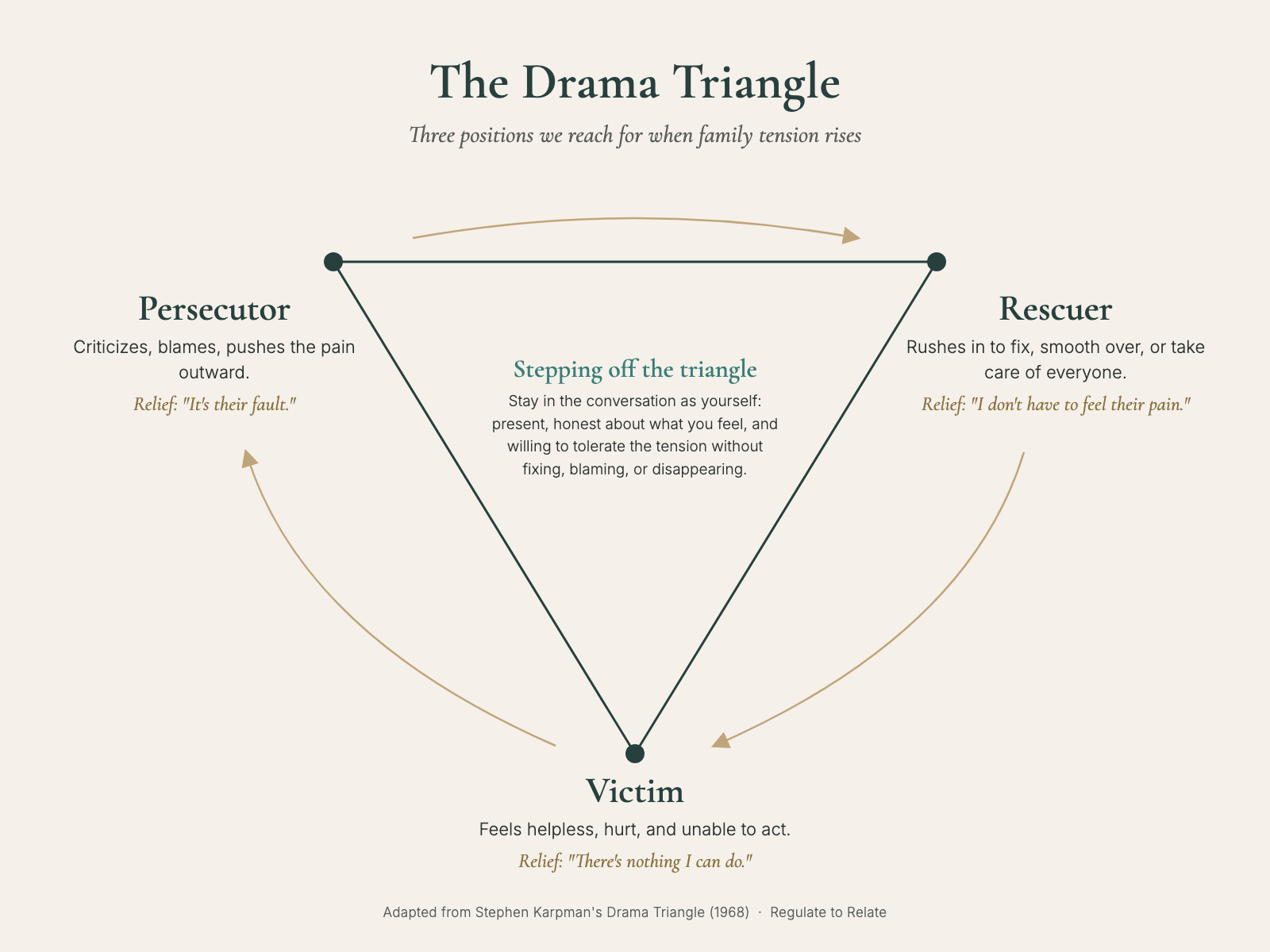
Each position offers a way out of the discomfort.
Each brings a moment of relief, and each one takes us a little further away from ourselves and from each other.
Stepping off the triangle means staying in the conversation as yourself: present, honest about what you feel, and willing to tolerate the tension without fixing, blaming, or disappearing. It is uncomfortable, and it is also where your brother can see the real you and you can see the real him, without anyone needing to be saved or blamed.
Most of us have one person in the family who feels different. The aunt who asked about your life and listened to the answer. The grandfather you could sit beside for an hour without saying a word. The cousin you text from the bathroom during dinner, who sees the whole thing and loves you anyway.
Think about how your body feels around them. Your breath slows and drops lower, and your shoulders soften. You laugh because something is funny, not to fill a silence. You can say "I'm having a hard year" and let it be true, without bracing for anyone's reaction.
With this person, you don't have to leave yourself to be loved. Your body knows it, and it relaxes.
Let that feeling reassure you. It means you already know how to be yourself in this family. Some part of you has been doing it for years, every time you were with them. The role formed around a parent's moods, a short temper, an awkward silence. With your exception, there was no mood to manage and no temper to head off, so you could relax and be yourself: your opinions, your humor, and your bad days, all welcome.
Notice what they give you. They want nothing from you in that moment. They are curious about who you are now, instead of being certain they already know. They let you have a bad mood without taking it personally or rushing to fix it. They stay steady when the table gets tense, so you never have to be the one to fix it for them.
You can grow these same qualities in yourself, and the people around you will feel the difference. Somewhere at that table, a niece or a younger brother is being handed a role right now, giving up a piece of themselves to stay close. You can become the relative that child relaxes around, the one who asks about their life, listens to the answer, and loves them without needing them to be anyone else
You can stay with your family without leaving yourself. You can still be the one who remembers the birthdays and clears the table. The difference is that you choose from a position of agency, knowing you could also choose otherwise.
That choice belongs to you. Your family will ask, sigh, and expect, and they will react to what you do. You can't control any of that. What you do in response is yours.
This is your sovereignty of choice: the right to decide, in each moment, whether you step into the role or stay with yourself. No one can take that from you, and no one can make that choice for you.
Change begins in the moment the familiar tension rises. First, notice it in your body: the reach for the dishes, the joke forming to cover a silence, the brace before the comment you know is coming. Then, instead of doing the automatic thing, stay with what you feel. Let the silence be a silence, and let someone else refill the glasses.
Feel the tightness in your chest, the heat in your face, the urge to get up and fix something, and stay in the discomfort without reaching for the old relief. The first few times, it will feel almost unbearable, because your body is waiting for the rejection it learned to expect.
You don't have to grit your teeth through it. When the tension feels like too much, give your body something to calm it, instead of something that pulls you back into the role. Excuse yourself to the bathroom for a few minutes. Slow your breathing, letting each exhale last longer than the inhale, which slows your heart rate. Splash cold water on your face, especially across your forehead and around your eyes, which sets off a reflex that slows your heart. Running cold water over your wrists can also help you feel more present in your body. Step outside for a short walk around the block. Each of these gives your nervous system a chance to regulate so you can return to the table as yourself, instead of the role.
Staying with yourself in these moments is a skill you build through practice; each time you feel the familiar tension rise and stay with it a little longer than before. These patterns are decades old, formed when you were too young to choose anything else, and it is completely understandable if you can't untangle them on your own. Many of us need a therapist or coach to build this capacity, and having someone beside you while you practice makes it far easier to keep going. If you would like help with this, you can reach out to me.
More often than not, that rejection doesn't come. The conversation moves on, and your mother passes the potatoes. You are still there, and so are they. Each time you stay with the tension and the old ending doesn't arrive, your body learns something new: you can remain yourself and remain connected. That is how capacity grows, through living something different, often enough, for long enough.
You will slip, and that is part of learning anything this old. Sometimes you will still reach for the dishes or make the joke. This role took years to form, and it will take time to loosen. Every moment you catch it, even afterward in the car, counts. Before you go, pick one moment to practice: one time you will stay seated, one tense exchange you will let unfold without you, one true thing you will say about your year.
If your role formed around real danger, such as a parent's addiction, violence, or abuse, your safety comes first, and distance may be the healthiest and most loving choice you can make for yourself. Stepping back from someone who hurt you can be the most protective thing you do for yourself, and you are the one who knows when that is true for you.
I think of this as the heart of staying without disappearing: being with the people you love while staying fully yourself. In the next essay, we'll look at what happens when we try to change the terms out loud, and the difference between a boundary, a wall, and an ultimatum. Until then, choose one moment at your next family gathering, and stay in it as yourself.